If you buy a newly built house in Illinois, the garage is supposed to be ready for an electric car. Well, partly ready. The state’s Electric Vehicle Charging Act, which took effect on January 1, 2024, requires new homes to be “EV-capable.” That means the hard parts of the wiring job are started, but nobody has to finish it.
What the Law Requires#
The Electric Vehicle Charging Act (765 ILCS 1085) passed as Public Act 103-53. It covers a few different kinds of housing:
- New single-family homes and small multifamily buildings (2 to 4 units): at least one EV-capable parking space for each unit that has dedicated parking.
- New large multifamily buildings (5 or more units): 100% of the parking spaces must be EV-capable. The same applies when a developer renovates a large building to convert it into condos, unless that would mean digging up an existing parking lot.
- Affordable housing developments: these got a later timeline and their own requirements.
The law also protects people who already live in condos and common interest communities. An association can’t ban or unreasonably restrict a unit owner from installing a charger at their own parking space. If the association doesn’t deny an application in writing within 60 days, it’s considered approved. There are similar protections for renters.
What “EV-Capable” Actually Means#
This is the important part. Under the law, an EV-capable parking space has:
- Reserved panel capacity: The electrical panel needs space for a 2-pole breaker and enough spare capacity for a 208-volt or 240-volt circuit of 40 amps or more.
- A continuous raceway or conduit: It runs from the panel to an enclosure or outlet box within 3 feet of the parking space.
- A label: Both ends are marked “For future electric vehicle supply equipment (EVSE).”
What the law doesn’t require is just as important. The builder doesn’t have to put in the 240-volt outlet, the NEMA plug, or a charging station. The law even spells out that builders don’t have to run wire through the conduit. You get an empty pipe and a reserved spot in the panel.
The law separately defines “EV-ready,” which means an actual branch circuit ending in an outlet or junction box, and “EVSE-installed,” which means a charger is fully installed. Neither of those is required for new homes.
My Ope-pinion: Good Start, Weird Stopping Point#
I think this is a good basic step. It’s long-term thinking. A house lasts for decades, and the people who live in it and the technology they use can change a lot over that time. Whoever buys a home built today may not drive an EV, but the next owner, or the one after that, very likely will.
Developers pushed back on the requirement, which isn’t surprising. They don’t like any new requirement or added cost, even a small one. But running conduit while the walls are open is cheap compared to doing it after the drywall is up and painted. The law itself says the goal is to provide “the electrical elements that are difficult to install during a retrofit.”
Still, stopping without the outlet is a weird place to stop. The conduit is already there and the panel space is reserved, so pulling wire and putting in a receptacle is a small job during construction. Leaving it off means the homeowner has to call an electrician later anyway, and that’s an inconvenience. The empty panel space can also get used up. Over the years, other projects like a hot tub, a new air conditioner, a workshop, or a finished basement can claim that spot in the panel before anyone gets around to the car. A dedicated outlet makes the reservation stick.
What It Looks Like Without It#
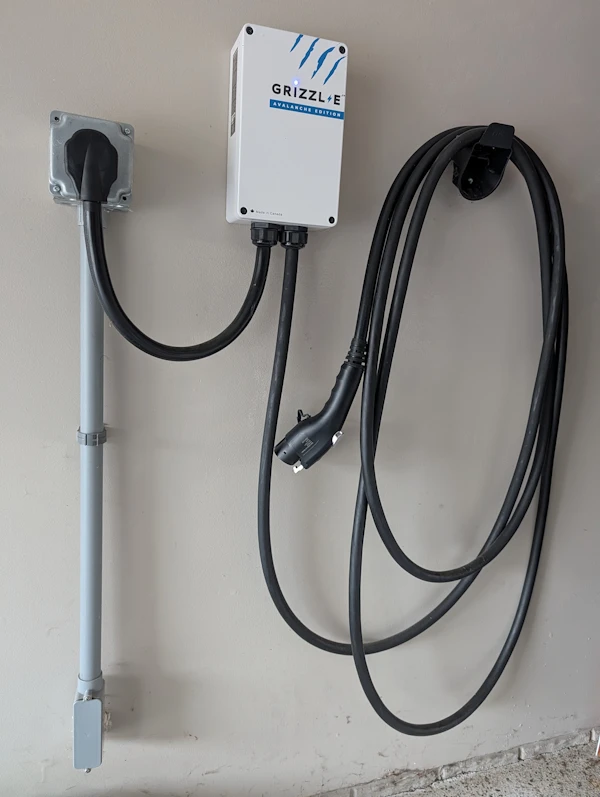
My house is older, so it didn’t come with any of this. When I got my EV, I hired electricians to run a new circuit to my garage so I could install a Level 2 charger. The photo above is the result: a 240-volt outlet, with the conduit running up the garage wall to it, and the charger mounted beside it.
It works great, and Level 2 charging at home is one of the best parts of owning an EV. But if the outlet, or even just the conduit, had already been there, the job would have been easier and the result would look nicer. I got lucky. My electrical service is fairly close to my garage, so the run wasn’t long and the electricians didn’t have to go through any finished walls. Plenty of people aren’t that lucky. If the panel is in a basement on the far side of the house, the same job can mean fishing wire through finished walls and ceilings, or running a lot of surface conduit, and the cost climbs fast.
If You’re Building or Buying New#
If you’re buying a new home in Illinois, ask the builder where the EV-capable space is and what’s at the end of the conduit. If you’re working with a builder before construction, it may be worth paying a little extra to have the wire pulled and a 240-volt outlet installed now, while it’s easy. Even if you don’t plan to buy an EV, it’s a feature the next buyer may appreciate.
And if you’re in an older house like mine, have an electrician take a look at your panel and the path to your garage before you shop for a charger. The answer to “how hard will this be?” depends a lot on where your panel is.
Sources: Illinois General Assembly: Electric Vehicle Charging Act (765 ILCS 1085).